 Sacred Drop
FoodWorx, the Future of Food: Part II
Posted on March 10, 2014
FoodWorx PDX is an annual conference focused on how the world of food is evolving and the challenges involved in this evolution. As laws change, as people change, as cities change, the world around them changes. This is part two of the conference regarding food insecurity, Chefstable, and My Street Grocery.
Dana Gunders of the Natural Resources Defense Council threw some hard-hitting facts at us. I was stunned to learn that in the United States one in six people are food insecure. What does “food insecure” mean? It means that on a daily basis, approximately 16 percent of Americans do not have access to food and are therefore hungry or in fear of starvation. On top of that, did you know that 40 percent of the food in this great nation is not eaten? I was astounded by this fact. That means that on your plate, you will eat 60 percent of your food, and the rest will be wasted while there are one in six people starving. Dana pointed out, “If food waste were a country, then it would rank 3rd in Green House Gas emissions. This food is actually the number one contributor to landfills, and because of it creates an incredible amount of methane.“

Did you know this simply means the food is at its peak and not an expiration date?
Another interesting fact is that the size of a standard cookie has quadrupled in size since the 1970’s. Again, compared to the 1970s, Americans waste 50% more food than they did back then. So what can we personally do to remedy these issues of food waste? Dana’s recommendations were the following: 1) create a shopping list and plan your meals; 2) avoid the massive bulk purchases; 3) use your freezer to store additional meals; 4) learn your labels and really know for a fact when your food is bad (the “Best by…” label simply means that the food is at its peak, not that it should be thrown out); 5) stop demanding perfect food—an incredible amount of food is thrown away for simple imperfections in color.
Following Dana’s talk came Kurt Huffman from Chefstable, discussing what sells and what doesn’t. Chefstable was created to allow chefs to focus on what they are good at—their passion, which is food—and not on running the business. He emphasized three principal components of making a restaurant “hot:” 1) Environment, creating a space that is comfortable; 2) Service, which is what is most written about; enthusiasm is key, because, in Kurt’s words, “ it is better to be an enthusiastic idiot” than just an idiot; 3) Product–Yes, product is sadly the least important but still necessary. Kurt then went on to talk about what investors look for: 1) Team—what they are really investing in; 2) Neighborhood—does it make sense; 3) The story—what is it. and is it likely to draw others; 4) The risk—because 90 percent of investments fail, are they willing to lose their money?
The conference concluded with some stunning storytelling videos by Rob of GLP Productions and an inspirational mobile grocery concept by Amelia Page of My Street Grocery aimed at providing fresh food access to all.
Rob Holmes, founder and chief storyteller of GLP Productions, talked about the four key elements of storytelling. Every story must have a purpose, a location, a journey, and a character. He used several videos to demonstrate each of these aspects. The one that I enjoyed the most was the emphasis on the key character of a story. He or she doesn’t have to be a CEO; the key character just has to be a person who is authentic and easily relatable, and who has a great story to tell.

Amelia Page, a young twenty-something, came on stage and talked about the fact that over 23 million Americans don’t have access to fresh food, creating food deserts. Her solution? It was to create a mobile grocery truck called My Street Grocery, which visits these food deserts and provides neighborhoods with a chance to buy local, seasonal fresh food at reasonable prices. She uses this as a way to educate people on food as well as to help them with planning their meals through meal kits that cost approximately $2 to $3 per serving. This enables people to eat healthy without having to rely on unhealthy food alternatives such as fast food restaurants. She started in Portland and hoping to expand this to other food deserts in the United States.
Overall, this conference was a very interesting and eye-opening event in which I was motivated to “heed my call,” eat at home more with local food, and waste less, and, when I feel adventurous, visit and support the local food vendors in Cartopia.
Thank you for joining me. For more information on the event visit: http://www.foodworxconference.com/
April Yap-Hennig is a wine lover and marketer at heart. She is co-founder and owner of Epicurean Media, a beverage and food artisan public relations and marketing consultancy as well as writes for the Sacred Drop Channel at www.sacreddrop.com. For more information on April, please visit her website www.about.me/aprilyaphennig and www.epicureanmedia.com.
Foodworx PDX, the Future of Food: Part I
Posted on March 7, 2014
Imagine being a person with a dream, a dream to one day do something you love, and imagine that your dream is to be the owner of a food cart or maybe of a restaurant? If what I am describing sounds like you or someone you know, then you should have been at this conference.

FoodWorx PDX is an annual conference focused on how the world of food is evolving and the challenges involved in this evolution. As laws change, as people change, as cities change, the world around them changes. I met people of various backgrounds—from tour operators like ForkTown Food Tours, to food truck managers like Koi Fusion, to hops soda makers like Portland Soda Works—all of them with the dream of capturing the attention of the people of Portland.
Forget basketball, forget soccer. Think food. “Eating is our biggest sport in Portland,” stated Erik Wolf of the World Food Travel Association, “Food tourism starts at home.”
What better home than Portland to start exploring your backyard?
I moved to Oregon from Spain and was so surprised by the number of food carts and the abundance of selection Portlandia people had. While at this conference, as a relative newbie, a friend of mine, Bee Talmadge, owner of The Spicy Bee and manager of Koi Fusion, stated, “You haven’t been to Cartopia?” No, I have not yet been to Cartopia. I’m guessing I need to go. Just in case you are a relative newcomer to Portland, it is on SE 12th and Hawthorne Blvd and is the land of the best food carts in Portland.
The Power of “And”
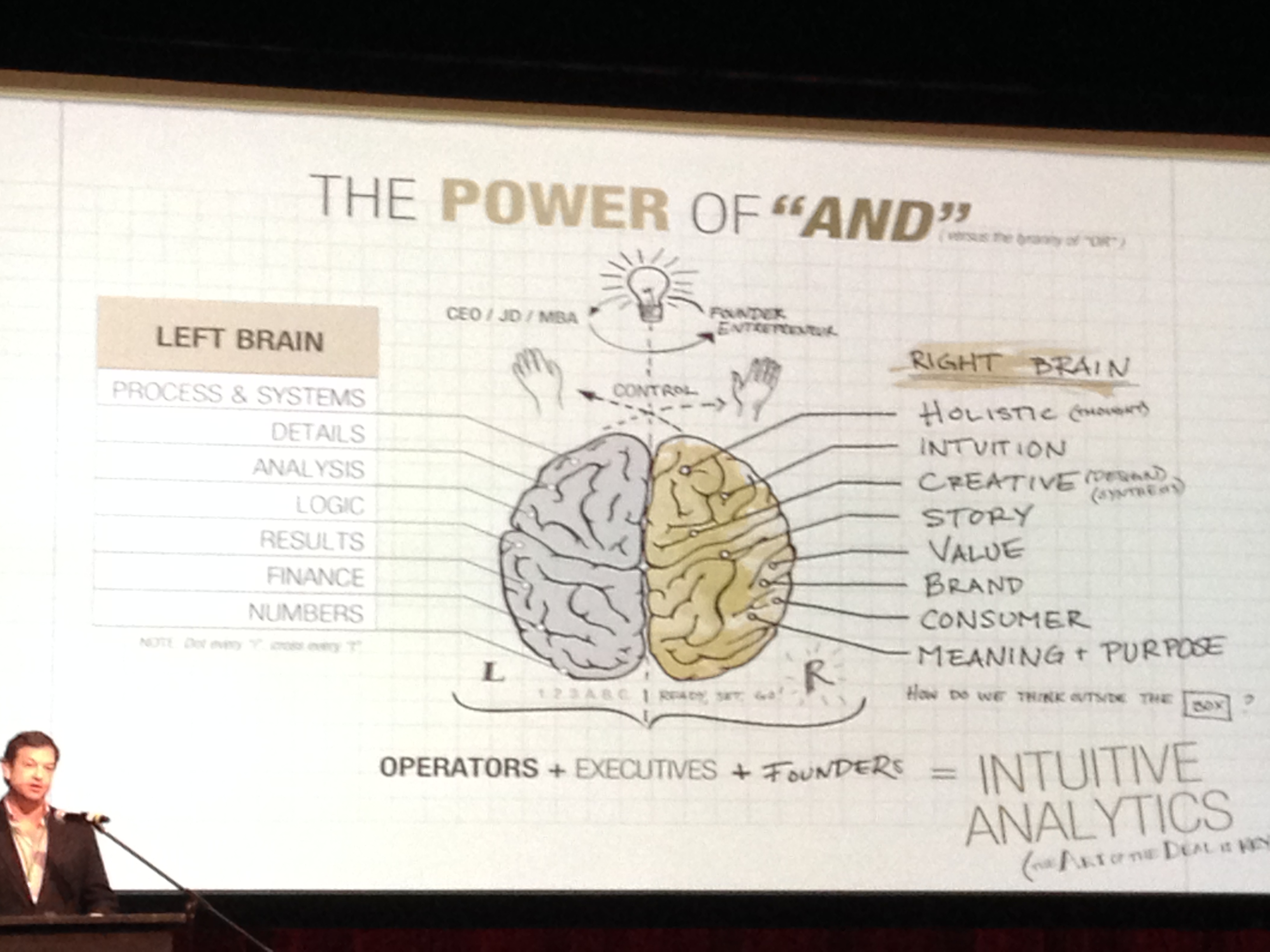
Given that there is a demand for great food at reasonable prices, there are “cartrepreneurs” and other food-related entrepreneurs springing up everywhere in Portland. David Hewitt of the Meriwether Group just wrote a book, Heed Your Call, to support all those who are seeing guidance. His book talks about how “human values can be expressed through business.” With his wife, David initially launched Oregon Chai in 2004 and had tremendous success of bringing together two people, one with a dream (right brain—hers) and one with a business mind (left brain–his). He emphasized the importance of the “Power of ‘And’.” This Power of And theory stresses that you need to be all three: an Operator, an Exec, and a Founder. By being creative and being logically minded, you can create a successful business.
Gregg Abbott, owner of Whiffie’s Fried Pies and head of the Oregon Street Food Association, talked about the new consumer demand by an educated constituency that demanded “novel food experiences.” He said that the Portland food carts scene has created a drive back into city centers. More and more cities with downtowns want the formula to duplicate this incredible economic driver. This is easier said than done. The Portland food cart phenomena is due through the convergence of ideas, opportunity and demand—all factors that need be readily available to recreate Portland’s enormous success.
Perhaps Portland’s success has also been this overall drive back to all things sustainable. By “sustainable,” I mean local, wholesome, homemade, and economical. Food that is created, as Lisa Schroeder of Mother’s Bistro states, “from squeak to wag.” Food made the way it was before the 1900’s when people used to eat slow-cooked meals at home that were made with love. We are now facing a wake-up call where the cost of exotic foods has gone up with the cost of gas, where fine dining is just too expensive, where climate change is affecting our food supplies and where industrial agriculture is affecting our health. There is a return to the old ways in Oregon, where there is a demand for food markets and microproducers. People are raising their own backyard chickens and pickling their own vegetables. This is the start of the “Locavore” movement and perhaps a return to our great grandmother’s cooking.
Stay tuned for Part Two on food insecurity, My Street Grocery, GLP Films, and Chefstable next week.
For more information on the event visit: http://www.foodworxconference.com/
April Yap-Hennig is a wine lover and marketer at heart. She is co-founder and owner of Epicurean Media, a beverage and food artisan public relations and marketing consultancy as well as writes for the Sacred Drop Channel at www.sacreddrop.com. For more information on April, please visit her website www.about.me/aprilyaphennig and www.epicureanmedia.com.
This was also posted on www.winerabble.com .
Unique Portugal: An interview with the venerable Tony Smith
Posted on March 3, 2014 1 Comment
I had the chance to sit down with the venerable Tony Smith of Lima Smith Lda., which owns Quinta de Covela and Quinta da Boa Vista of northern Portugal. This was a unique opportunity to sit down with this former editor, previously based in the UK, of Conde Nast and discuss how he went from being a editor to the owner of these prestigious properties in the Douro River Valley. Tony went from living in São Paolo, Brazil (population: 58 million), to São Tomeo (population: 681). In the interview, he talks about his experience with this change as well.
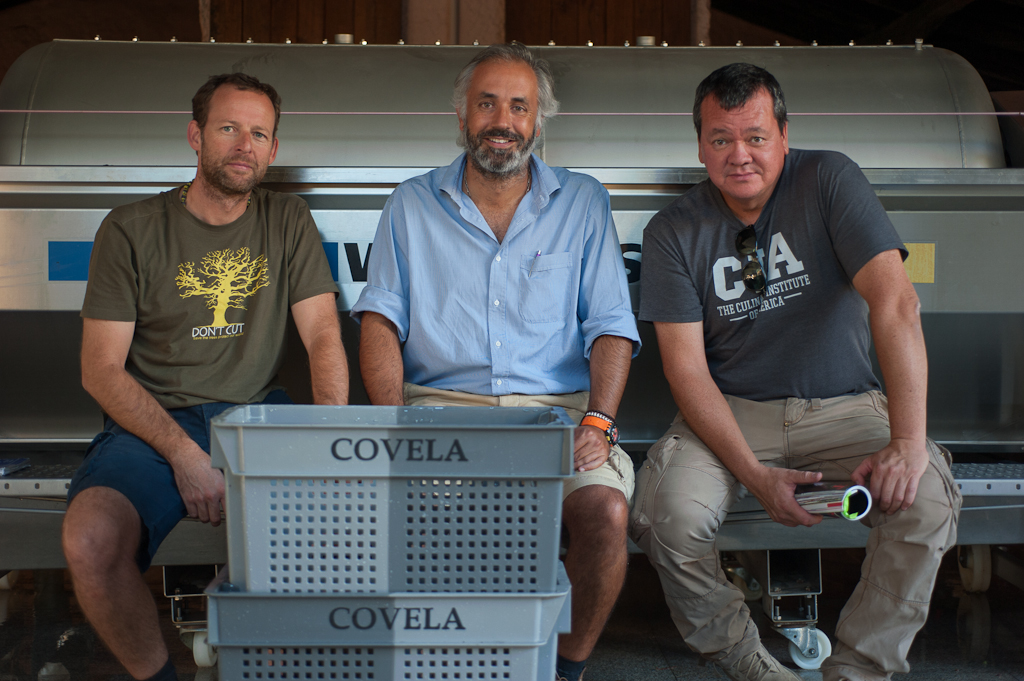
The Covela Boys: Gonçalo Sousa Lopes, viticulturist; Rui Cunha, winemaker; and Tony Smith, partner; at the end of the 2012 harvest
Lima Smith Lda. is the brain child of Tony Smith and Marcelo Lima. They both initially purchased Quinta de Covela through an auction in 2011. They later went on to purchase Quinta da Boavista, a former Offley estate from Sogrape Vinhos, in 2013, and also took over the Quinta das Tecedeiras brand.
I had the opportunity to visit Quinta de Covela and stay on the estate. It had the most gorgeous views of the valley and was situated in the middle of the Vinho Verde region of the Douro River Valley. The estate has 70 hectares, with approximately 20 hectares-49 acres of vines under production, with another 50 hectares available to plant. Right now their current production is about 100,000 bottles—8,333 cases of 12 bottles—annually.

Dating back to the 1500s, the estate was formerly known as Casa de Covela, where, to this day, the ruins of the old stone Renaissance manor home still remains. The estate went on to belong to various owners, but in 1980s it was acquired by the businessman Nuno Araújo, who created the brand Covela. In 2007, Casa de Covela gained the classification as a bio-dynamic producer, which at the time was above and beyond what others in the region had done. Unfortunately, the estate was later abandoned, and when the property was first purchased in 2011, it was in disrepair and in need of a little TLC. After two years of neglect, Lima Smith picked up the winery and, resurrecting it, refocused it from 50/50 red-to-white production to 20 percent red and 80 percent white under the direction of renowned winemaker Rui Cunha.
Rui had been involved in the original project back in 1992 and later returned to help revive this beautiful property; he also has a consultancy and makes his own wines through Secret Spot. Rui made the decision to return to help rebuild Covela because he could finally make the wines he always wanted to under the new ownership. When he came back to Covela, he was able to make a single variety wine out of the Avesso grape variety, which has now gained national acclaim. This grape variety wine turns out to be one of my favorite Vinho Verdes.
Wine Notes: Avesso 2012 Edicion Nacional. Covelo- first vintage.
Sold out (Unfortunately!)

Covela Vinho Verde 2012 Avesso
It has a touch of baked goods with a crisp lemon-lime mouth; it is dry and delicious.
Price: $16.
Importer: David Boland
The winery has sold its wines mainly in Portugal in the past, but its focus for the future is to sell 40 percent of their wines nationally and sell 60 percent internationally, first into 3 new markets opened this past year: US, Brazil, and Germany, with plans for three other new markets.
NEWS:
In recent news, Quinta de Covela was just awarded the Trophy of “Best Viticulture” at the annual 2014 gala of “The Best of the Year” organized by Revista de Vinhos magazine. This is one of the most prestigious awards of the wine and gastronomy industry in Portugal. Congrats!
For more information on Quinta de Covela, visit www.covela.pt/en
This concludes my series on Portugal. Next up is Portland and the urban winery movement as well as additional regions of interest in Oregon. If there is something you are interested in learning about tweet me @SacredDrop or leave a comment below.
Thanks for joining us! Make sure to sign up to receive notifications of newest posts by email.
 Sacred Drop