 Sacred Drop
“Sideways” at the Wine Bloggers Conference…#WBC14
Posted on August 13, 2014

I often get asked the question, “Where were you last week? I saw a million pictures and videos popping up! Looks like it was fun!” To this I reply, “Oh, I was at the Wine Bloggers Conference, the #WBC14 event, where anyone who writes about wine, who loves wine and shares it with the world, comes together in one place to share experiences and enjoy the wine of the region together.” According to Zephyr Adventures, the organization who runs it, “The Wine Bloggers Conference, having started in 2008, is the granddaddy of most niche blogging conferences. It has sold out every year and now attracts around 350 participants each year. The conference is an excellent opportunity for bloggers to connect with and learn from other bloggers as well as wineries, vintner associations, tourism marketing associations, and other wine-related businesses. The conference draws top keynote speakers and key industry representatives in addition to the many bloggers.”

The rolling hills of St. Ynez Valley
This year, it was in Santa Barbara, a place I had visited before and adored due to the sun, surf, and rolling hills. This time, I got to really try the wines in true detail. More specifically, I went to the region surrounding the quaint town of Buelton…yes, this is the Buelton, of the movie Sideways. Sideways is now celebrating its tenth year of snubbing Merlot and exalting Pinot Noir. This movie had a huge impact on the wine industry. In the April 2008 issue of Wine Business Monthly, George Schofield refers to the “debacle following the release of the ‘Sideways’ motion picture” when discussing the effects of the movie on Merlot sales. Did this movie really alter consumer-buying patterns and change demand for either Merlot or Pinot Noir? “Sideways” was released on Oct. 22, 2004, ten years ago, and it was nominated for five Academy Awards on Jan. 25, 2005. It won one, for best-adapted screenplay,–and closed May 19, 2005. With popularity like this, how much does movie culture ultimately affect the wine industry?
In the panel, “The U.S. Wine Consumer: Who, What & Where,” given by Wine.com, it found that there was a significant effect on consumer behavior after 2004 and the movie is still impacting sales today. Initially the sales of Merlot went down, while the sales of Pinot Noir skyrocketed. This affected not only consumer behavior but also wine-growing decisions. More acreage was dedicated to Pinot Noir, and the movie also made the US more open to new wine regions, such as Oregon and New Zealand, growing Pinot Noir. Meanwhile, Merlot, was considered a shunned grape variety, at least for a few years and struggled to compete with the popularity of Pinot Noir.
In a 2012 article in the Wall Street Journal on Merlot, referring to wine retailers, Lettie Teague stated, “Merlot sales were stable at best and at worst were losing ground. In most cases, Merlot drinkers had simply moved on to other varietals such as Tempranillo and Malbec.” In one marketplace in New Jersey, Merlot sales were considered “slow” and accounted for less than 1% of total wine sales. Moreover, these is less acreage dedicated to Merlot, at least in California, whereas in Washington the acreage has increased slightly. A study was done at Sonoma State on the “Sideways Effect, looking specifically into the change in demand for Merlot and Pinot Noir Wines (click here for the fascinating paper).
According to the Wine Institute, there were more than 53,000 acres planted to Merlot in 2006, but in 2012, there are now 45,000 acres planted to the grape. In Washington, acreage planted in Merlot grapes is up from 5,000 to 8,000 acres; however, for Cabernet Sauvignon, the acreage has doubled in the same amount of time.

Sideways, the Movie
In conclusion, yes, movie culture does have an effect on the wine industry and the culture surrounding it. However, don’t let what others are drinking necessarily affect what you will enjoy. I have always believed that if you love something, drink it! Who cares whether it is sweet, or dry, or Merlot?…Enjoy it, and share it.
A Thirst for Cider: Oregon Cider Week
Posted on July 6, 2014
What was once old is new again. This holds true not just for fashion but also for cider. The US has now experienced a cultural resurgence of cider and is developing quite a thirst for it.
Once Colonial America’s drink of choice, the U.S. is quickly returning back to its roots for inspiration. According to federal data, draft cider sales rose 700 percent between 2011 and 2012; in 2012, U.S. cider sales topped $90 million. Why? First, thanks to the interest and subsequent growth of craft beer, the craft cider industry has grown as well. Furthermore, the interest in and demand for something new and different, and perhaps healthier, has created the perfect opportunity for cider.
Data also suggest that the average cider drinker is 20-35 years old. A number of these younger drinkers, particularly in the Northwest, are looking for something authentic, original, and different from the mass-produced sub-par cider and beer. Given all of this data, the Pacific Northwest is the perfect place for a craft revolution.
The resurgence of interest in cider has been very notable in Oregon. On June 20, Oregon kicked off its third annual Oregon Cider Week with Cider Summit Portland, featuring over 140 ciders from 37 producers, from 6 states and 7 countries. This event will continue on to Seattle, Chicago, and Berkeley. Portland showed its support by coming in droves: 3,000 to 4,000 visitors over two days, to be exact. It was a well-attended event with a lot of people enjoying the sun, the music, and the cider being poured by artisan cider houses. The rest of the week featured events throughout the state including a number of tap takeovers, happy hours, tastings, and dinners.

I had the honor of attending the Cider Feast Dinner at St. Honoré Boulangerie off SE Division Street in Portland. Hosted by St. Honoré Boulangerie, Chef Dominique Geulin, and Kevin Zielinski, E.Z. Orchards’ owner and cider maker, this five-course French-style dinner showcased ciders from Finnriver Farm and Cidery, Virtue Cider, Reverend Nat’s Cidery, 2 Towns Ciderhouse, and E.Z. Orchards.
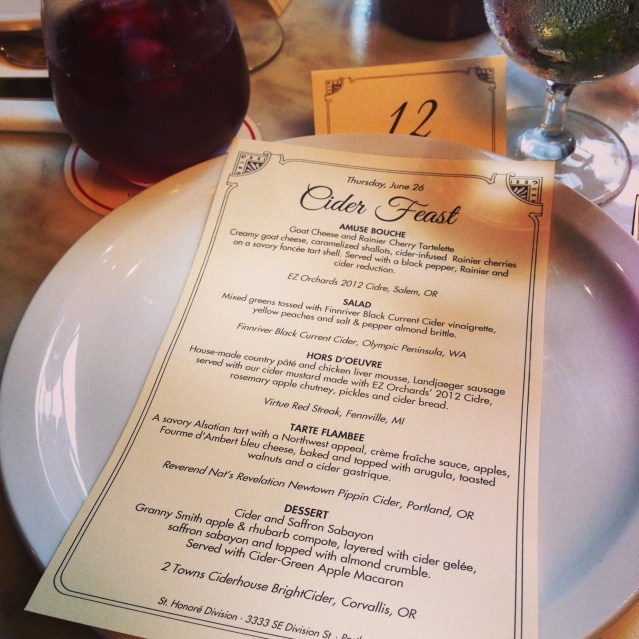
Cider Feast Dinner
The pairings dinner featured a beautiful Goat Cheese and Rainer Cherry tartalette, a mixed green salad tossed with Finnriver Black Currant Cider vinaigrette, a plate of country pâté and chicken liver mousse paired with a E.Z. Orchards cider mustard, and a gorgeous Alsatian-meets-Northwest tarte flambé. This feast was all finished off with a very interesting Cider and Saffron Sabayon.

For me, it was a beautifully-paired dinner by Chef Geulin, and I will make sure to return during St. Honoré Boulangerie’s happy hour for more cider-based cocktails soon. What is unique about St. Honoré Boulangerie is that they create not only beautiful breads and quiches but also wood-fired pizzas. I was happy to taste some of my favorite cider producers, from E.Z. Orchards to Finnriver to Reverend Nat’s, all paired in this great cider dinner. I look forward to seeing the other great events Portland has to offer.
Stay tuned!
Drinking Now: Villa Maria Sauvignon Blanc #NZSavvy
Posted on June 19, 2014 1 Comment
Wednesdays are known as #WineWednesday or #WW (hashtag WW) and are therefore the best days to hold what the wine industry calls Wine Chats or #winechat. These wine chats are held every Wednesday for an hour starting at 5:00 pm or 6:00pm PST/ 8:00 pm or 9:00 pm EST. Wine chats are meant to be educational and informative tools for not just wine bloggers but for those following them as a chance to learn more about wines within 1 hour though two-way communication between a winery/winemaker and hand-selected wine bloggers.
My first wine chat was through Protocol Wine Studio based in San Diego where we did a tasting of Argentinean wines. Following that I did another tasting for a series of Malbecs for Malbec World Day in April this year. Yesterday, I had the sincere pleasure of joining a Villa Maria New Zealand Sauvignon Blanc wine chat under the #NZSavvy. The purpose of a hashtag is to make it easier to follow a conversation from start to finish and join in on the conversation whether you have the wine in front of you or not. I personally use a tool such as TweetDeck which automatically updates me on the #winechat stream as it happens. In order to remain a part of the conversation, you have to make sure to include the all important # word that is being used specifically for that tasting. This way everyone on the stream can see you.
Make sure to check out the #winechat schedules for Protocol. There are also a few coming up in the upcoming weeks including one next week on Santa Barbara wines on Wednesday, June 25, just look for the #sbcwines or follow them on twitter @sbcwines.
Below you can see the chaos as it ensues…. glass of wine, wine notes, laptop and cell phone. All necessary elements of a #winechat.

The #NZSavvy #winechat begins!
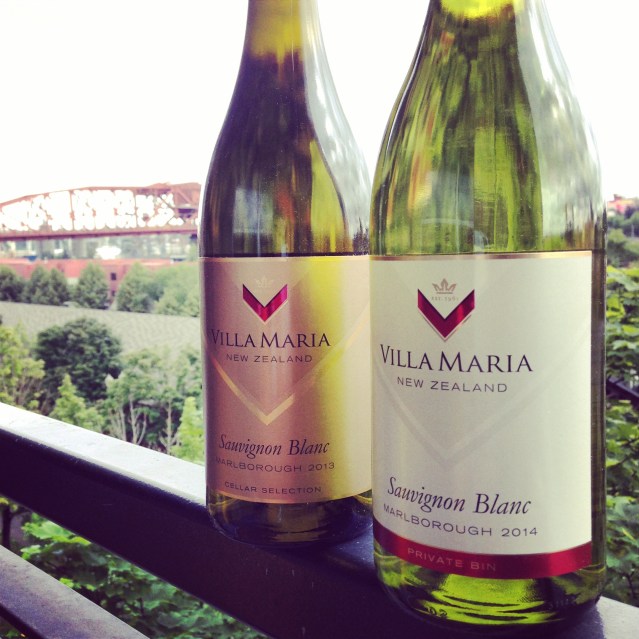
Last night I tried two Sauvignon Blancs from Villa Maria, both of which were beautifully refreshing change to what I have been currently drinking. I currently live in the world of Pinot Noir and Pinot Gris with a little Riesling and Chardonnay thrown in there from time to time. I welcomed the grassy, grapefruit and citrus palate like a refreshing wind on a summer day.
Honestly, it was really hot yesterday and I couldn’t have asked for a more refreshing drink. Sauvignon Blanc from Marlborough, New Zealand holds a special place in my heart as it is such a clearly distinctive palate that no other Sauvignon Blanc that I’ve tasted tastes like. To me, Marlborough Sauvignon Blanc has this fresh-cut green grass, almost asparagus nature to it, not in a bad way but in a delicate and refreshing way.
Marlborough is located at the top of the South Island in New Zealand. With over 23,600 hectares of planted vines, it is the largest wine growing region of New Zealand and primarily known for its world-class Sauvignon Blanc.
Marlborough enjoys high sunshine hours and a temperate climate which allows for a long slow, flavor-intensifying ripening period. Warm days and cool nights help keep the acid in wines high. The soil type is noticeably stony, sandy loam top soil with deep layers of shingle, this allows for fast draining and therefore low fertility soils. The one thing you always want for vines is to have them suffer a bit, this creates the complexity that can not be achieved solely through winemaking. It is a combination of the land, the weather of each vintage and the winemaker’s hand that can make any wine truly unique. In this case, the two below wines are highly recommended a true treat on a hot summer day. Enjoy!
2014 Villa Maria Private Bin Sauvignon Blanc
It really sings in the glass, highly aromatic with fresh-cut green grass, lime, kiwi and ruby-red grapefruit with a long-lasting finish and crisp acidity. This is a special early release. At $14.99, it would pair beautifully with some oysters.
2013 Villa Maria Cellar Selection
With a bit more time in bottle and allowing the wine to warm up a little, the nose just jumps out at you with lychee, grapefruit, green grass. In the mouth, passion fruit attacks your palate with a clean crisp acidic finish of a lemon-lime-grapefruit sorbet. Really quite delightful. Retail on this is $19.99.
I keep wishing I had some nice seafood, like a pan-fried fish, oysters, scallops and a side of seasonal vegetables, to pair it with but a beautiful view from my new place full of boxes and my trusty French Bulldog, El Guapo, will have to suffice for now. He really wanted some! Cheers!

 Sacred Drop